FOR INTERNET COURSES SELECT:
TERM: Summer 2014
LOCATION: Rutgers Online Courses
LEVEL: Undergraduate
SUBJECT: Comparative Literature (195)
COURSE TYPE: Online
Summer 2014
Undergraduate Courses
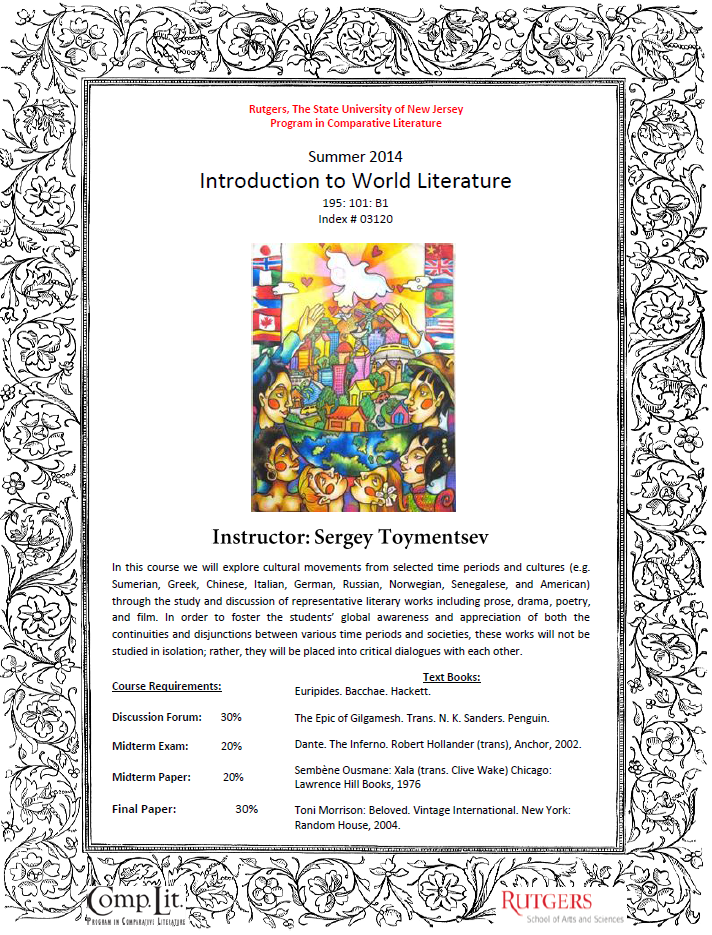
Introduction to World Literature - THIS IS AN INTERNET COURSE
195:101:B1; Index 03120; 05/27/14 - 07/03/14
Hours by Arrangement
$100 Online Course Support Fee
Online via e-College http://ecollege.rutgers.edu
Open to High School Seniors
Instructor: Toymentsev
Fulfills Core Learning Goal AHp
Does not count toward major or minor
In this course we will explore cultural movements from selected time periods and cultures (e.g. Sumerian, Greek, Chinese, Italian, German, Russian, Norwegian, Senegalese, and American) through the study and discussion of representative literary works including prose, drama, poetry, and film. In order to foster the students’ global awareness and appreciation of both the continuities and disjunctions between various time periods and societies, these works will not be studied in isolation; rather, they will be placed into critical dialogues with each other.
Text Books:
Euripides. Bacchae. Hackett.
The Epic of Gilgamesh. Trans. N. K. Sanders. Penguin.
Dante. The Inferno. Robert Hollander (trans), Anchor, 2002.
Sembène Ousmane: Xala (trans. Clive Wake) Chicago: Lawrence Hill Books, 1976
Toni Morrison: Beloved. Vintage International. New York: Random House, 2004.
Course Requirements:
Discussion Forum: 30%
Midterm Exam: 20%
Midterm Paper: 20%
Final Paper: 30%
______________________________________________________________________________
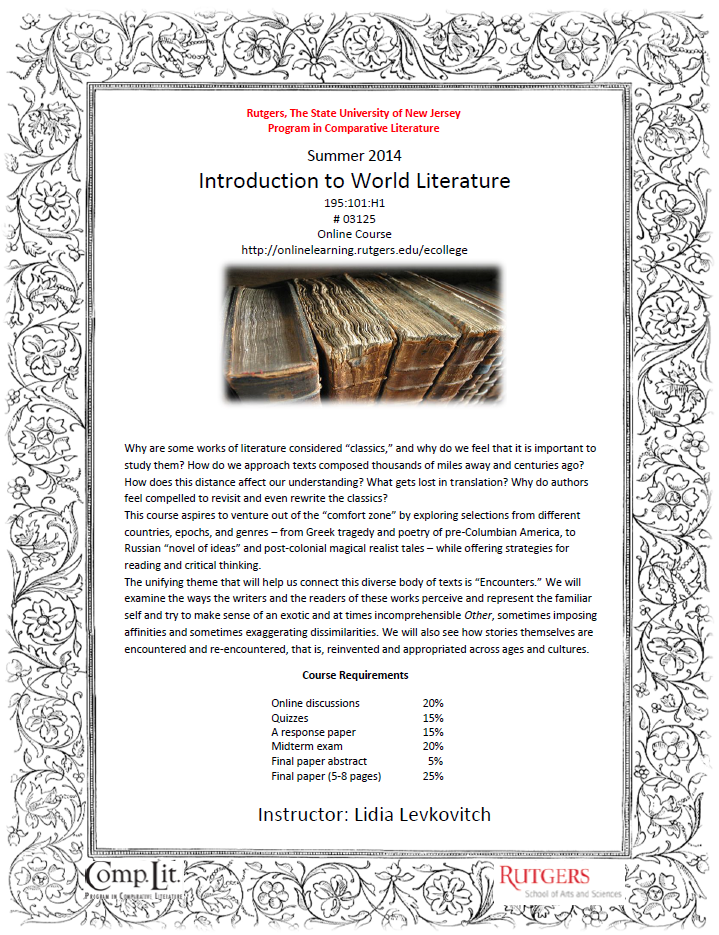
Introduction to World Literature - THIS IS AN INTERNET COURSE
195:101:H1; Index 03125; 07/07/2014 - 08/13/2014
Hours by Arrangement
$100 Online Course Support Fee
Online via e-College http://ecollege.rutgers.edu
Open to High School Seniors
Instructor: Levkovitch
Fulfills Core Learning Goal AHp
Does not count toward major or minor
Why are some works of literature considered “classics,” and why do we feel that it is important to study them? How do we approach texts composed thousands of miles away and centuries ago? How does this distance affect our understanding? What gets lost in translation? Why do authors feel compelled to revisit and even rewrite the classics? This course aspires to venture out of the “comfort zone” by exploring selections from different countries, epochs, and genres – from Greek tragedy and poetry of pre-Columbian America, to Russian “novel of ideas” and post-colonial magical realist tales – while offering strategies for reading and critical thinking.
The unifying theme that will help us connect this diverse body of texts is “Encounters.” We will examine the ways the writers and the readers of these works perceive and represent the familiar self and try to make sense of an exotic and at times incomprehensible Other, sometimes imposing affinities and sometimes exaggerating dissimilarities. We will also see how stories themselves are encountered and re-encountered, that is, reinvented and appropriated across ages and cultures.
Requirements:
Online discussions 20%
Quizzes 15%
A response paper 15%
Midterm exam 20%
Final paper abstract 5%
Final paper (5-8 pages) 25%
Preliminary book list (all books are available on Amazon.com; please confirm with the instructor before purchasing):
Sophocles. Antigone. In The Oedipus Cycle. Trans. Dudley Fitts and Robert Fitzgerald.
ISBN 015602764X
The Arabian Nights. Ed. Muhsin Mahdi, Trans. Husain Haddawy.
ISBN 0393331660
William Shakespeare. The Tempest. Any edition, or read online at Project Gutenberg
Aimé Césaire. A Tempest. Trans. Richard Miller.
ISBN-13 9781559362108
Fyodor Dostoevsky. Notes from Underground. Trans. Constance Garnett and Ralph Matlaw.
ISBN-13 9780452285583
Akira Kurosawa. Rashomon (1950) Criterion Collection DVD; available for streaming at Amazon.com and hulu.com (with subscription)
Other texts will be made available online
______________________________________________________________________________
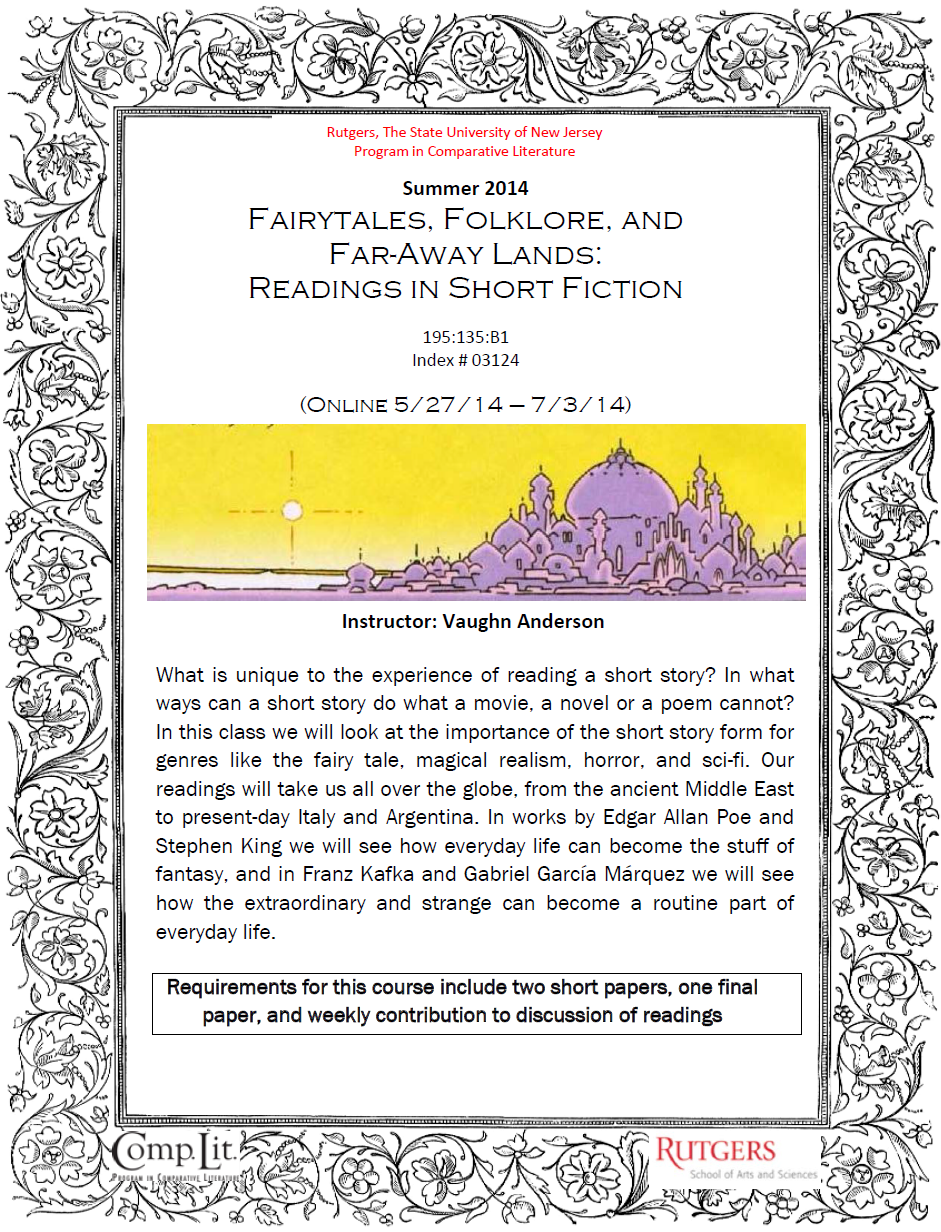
Introduction to Short Fiction - THIS IS AN INTERNET COURSE
"Fairytales, Folklore, and Far-Away Lands: Readings in Short Fiction"
195:135:B1; Index 03124; 05/27/2014 – 07/03/2014
Hours by Arrangement
$100 Online Course Support Fee
Online via e-College http://ecollege.rutgers.edu
Open to High School Seniors
Instructor: Anderson
Fulfills Core Learning Goal AHp
Does not count toward major or minor
What is unique to the experience of reading a short story? In what ways can a short story do what a movie, a novel or a poem cannot? In this class we will look at the unique importance to the short story form of genres like the fairy tale, horror fiction, magical realism, and science fiction. Our readings will take us all over the globe, from the ancient Middle East to present-day Italy and Argentina. In works by Edgar Allan Poe and Stephen King we will see how everyday life can become the stuff of fantasy, and in Franz Kafka and Gabriel GarcÃa Márquez we will see how the extraordinary and strange can become a routine part of everyday life.
Requrements:
2 short papers 40%
1 final paper 30%
weekly contribution to discussion 30%
All texts for this class will be available as PDFs through our eCollege site. ISBNs available for students who prefer to purchase books themselves.
______________________________________________________________________________
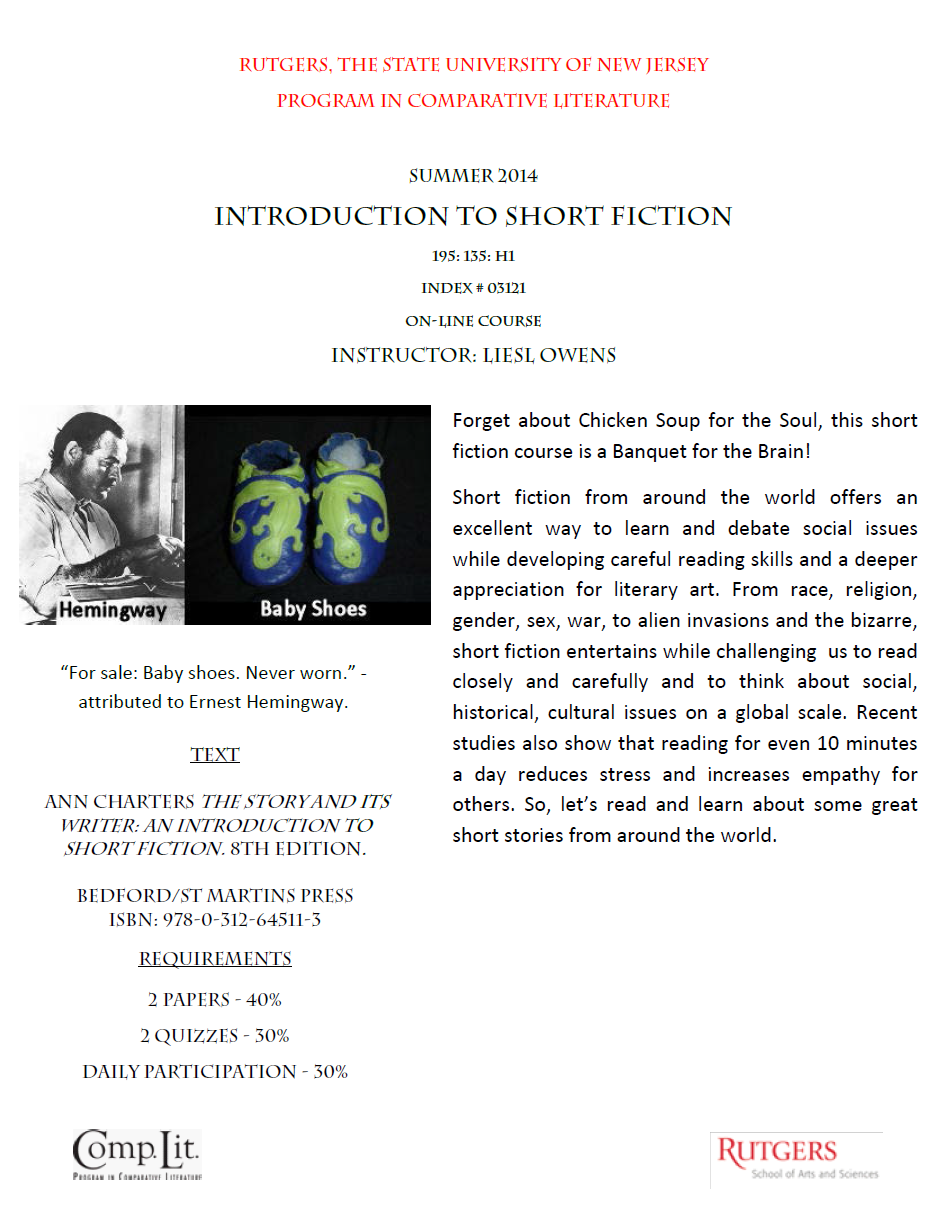
Introduction to Short Fiction - THIS IS AN INTERNET COURSE
195:135:H1; Index 03121; 07/07/2014 – 08/13/2014
Hours by Arrangement
$100 Online Course Support Fee
Online via e-College http://ecollege.rutgers.edu
Open to High School Seniors
Instructor: Owens
Fulfills Core Learning Goal AHp
Does not count toward major or minor
Forget about Chicken Soup for the Soul, this short fiction course is a Banquet for the Brain!
Short fiction from around the world offers an excellent way to learn and debate social issues while developing careful reading skills and a deeper appreciation for literary art. From race, religion, gender, sex, war, to alien invasions and the bizarre, short fiction entertains while challenging us to read closely and carefully and to think about social, historical, cultural issues on a global scale. Recent studies also show that reading for even 10 minutes a day reduces stress and increases empathy for others. So, let’s read and learn about some great short stories from around the world.
Texts - Ann Charters The Story and its Writer: an Introduction to Short Fiction. 8th edition. Bedford/St Martins Press ISBN: 978-0-312-64511-3
Requirements:
2 papers - 40%
2 quizzes - 30%
Daily participation - 30%
______________________________________________________________________________
World Mythology - THIS IS AN INTERNET COURSE
195:150:B1; Index 03126; 05/27/2014 – 07/03/2014
Hours by Arrangement
$100 Online Course Support Fee
Online via e-College http://ecollege.rutgers.edu
Open to High School Seniors
Instructor: Segura
Does not count toward major or minor
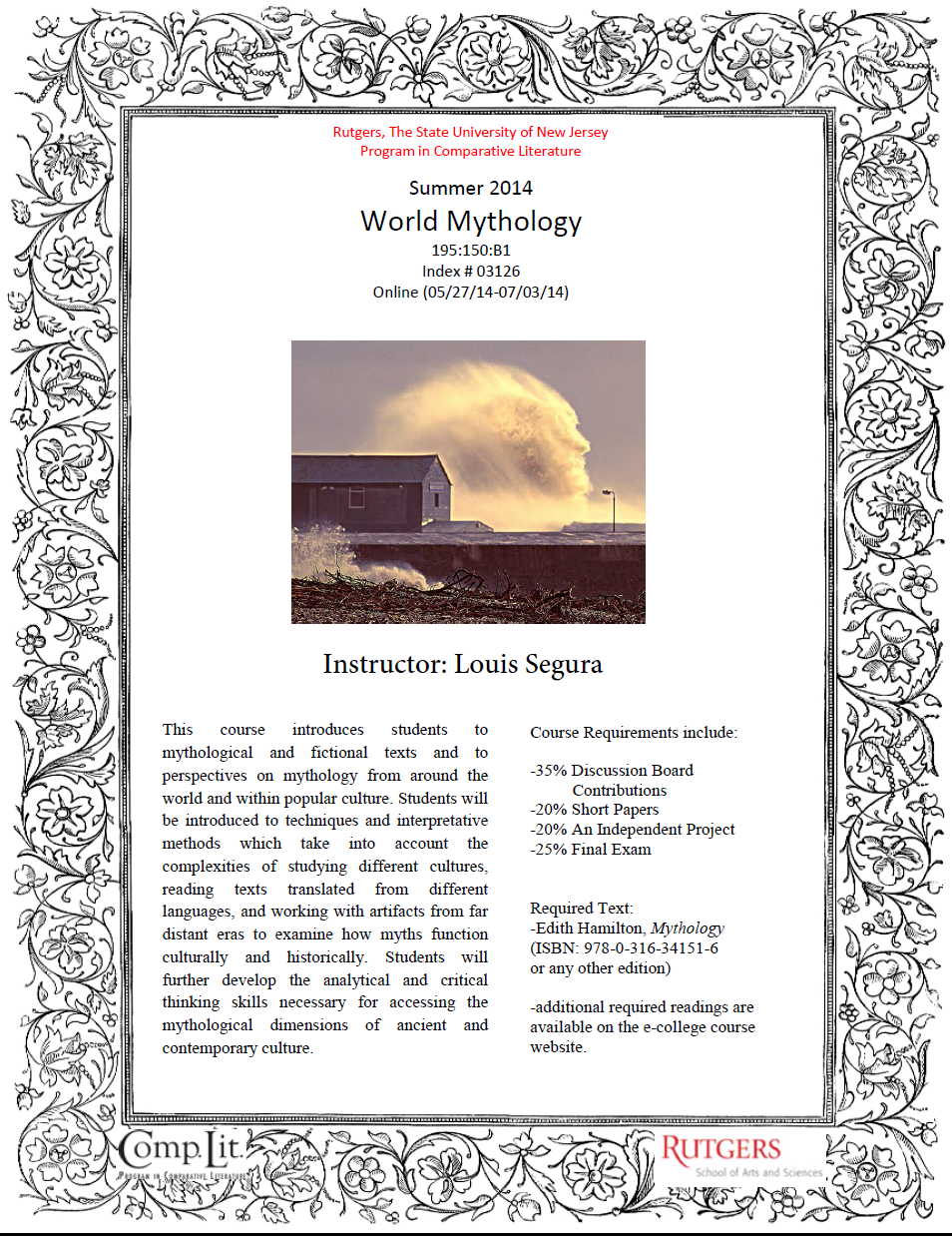
This course introduces students to mythological and fictional texts and to perspectives on mythology from around the world and within popular culture. Students will be introduced to techniques and interpretative methods which take into account the complexities of studying different cultures, reading texts translated from different languages, and working with artifacts from far distant eras to examine how myths function culturally and historically. Students will further develop the analytical and critical thinking skills necessary for accessing the mythological dimensions of ancient and contemporary culture.
Course Requirements include:
35% Discussion Board Contributions
20% Short Papers
20% An Independent Project
25% Final Exam
Required Text:
Edith Hamilton, Mythology (ISBN: 978-0-316-34151-6 or any other edition)
Additional required readings are available on the e-college course website.
______________________________________________________________________________
World Mythology- THIS IS AN INTERNET COURSE
195:150:H1, Index 03122; 07/07/2014 – 08/13/2014
Hours by Arrangement
$100 Online Course Support Fee
Online via e-College http://ecollege.rutgers.edu
Open to High School Seniors
Instructor: Gonzagowski
Does not count toward major or minor
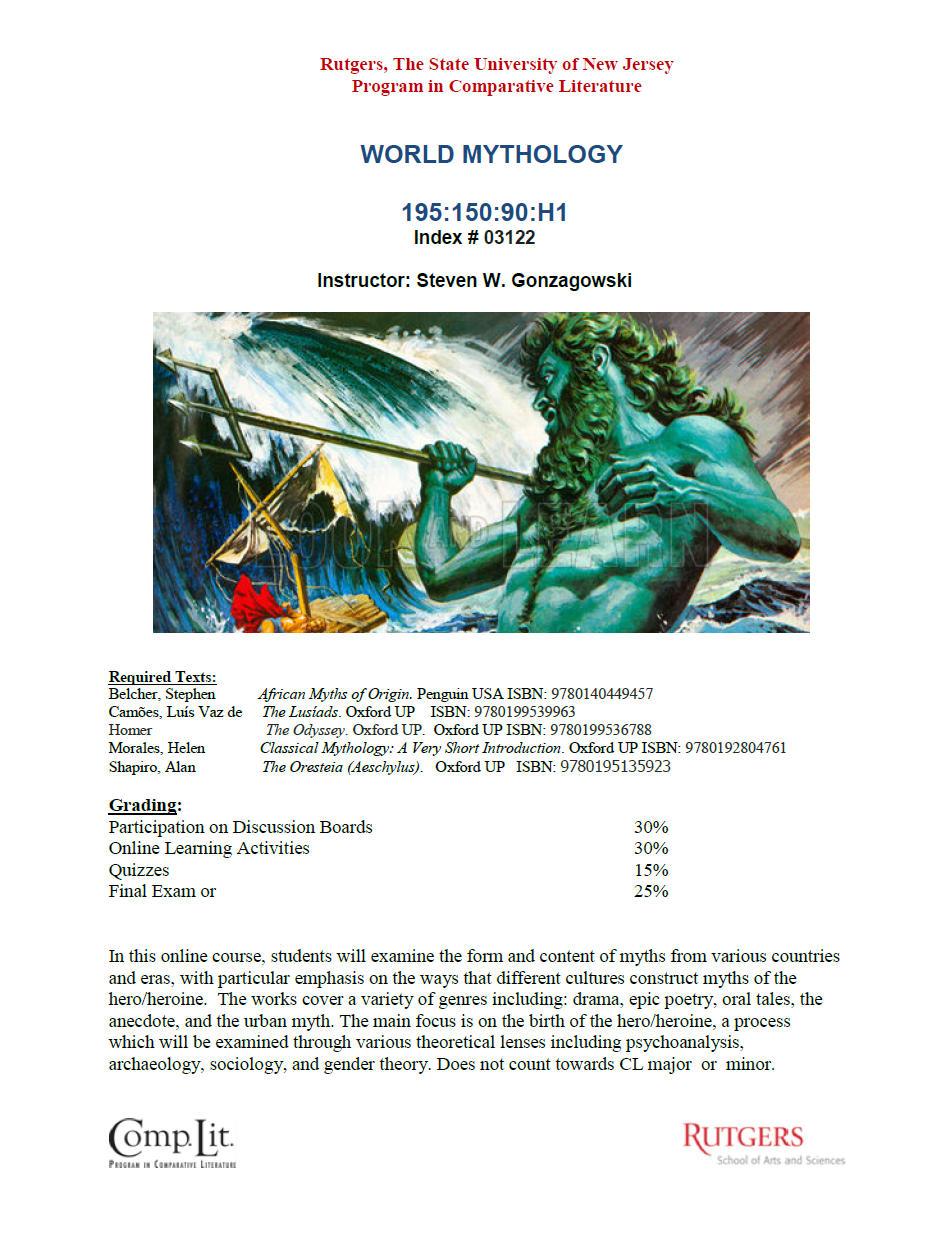
In this online course, students will examine the form and content of myths from various countries and eras, with particular emphasis on the ways that different cultures construct myths of the hero/heroine. The works cover a variety of genres including: drama, epic poetry, oral tales, the anecdote, and the urban myth. The main focus is on the birth of the hero/heroine, a process which will be examined through various theoretical lenses including psychoanalysis, archaeology, sociology, and gender theory.
Required Texts:
Belcher, Stephen African Myths of Origin. Penguin USA ISBN: 9780140449457
Camões, Luís Vaz de The Lusíads. Oxford UP ISBN: 9780199539963
Homer The Odyssey. Oxford UP. Oxford UP ISBN: 9780199536788
Morales, Helen Classical Mythology: A Very Short Introduction. Oxford UP ISBN: 9780192804761
Shapiro, Alan The Oresteia (Aeschylus). Oxford UP ISBN: 9780195135923
Grading:
Participation on Discussion Boards 30%
Online Learning Activities 30%
Quizzes 15%
Final Exam or 25%
______________________________________________________________________________
Introduction to Mythology- THIS IS AN INTERNET COURSE
195:244:B1; Index 03123; 05/27/2014 – 07/03/2014
Hours by Arrangement
$100 Online Course Support Fee
Online via e-College http://ecollege.rutgers.edu
Instructor: Coleman
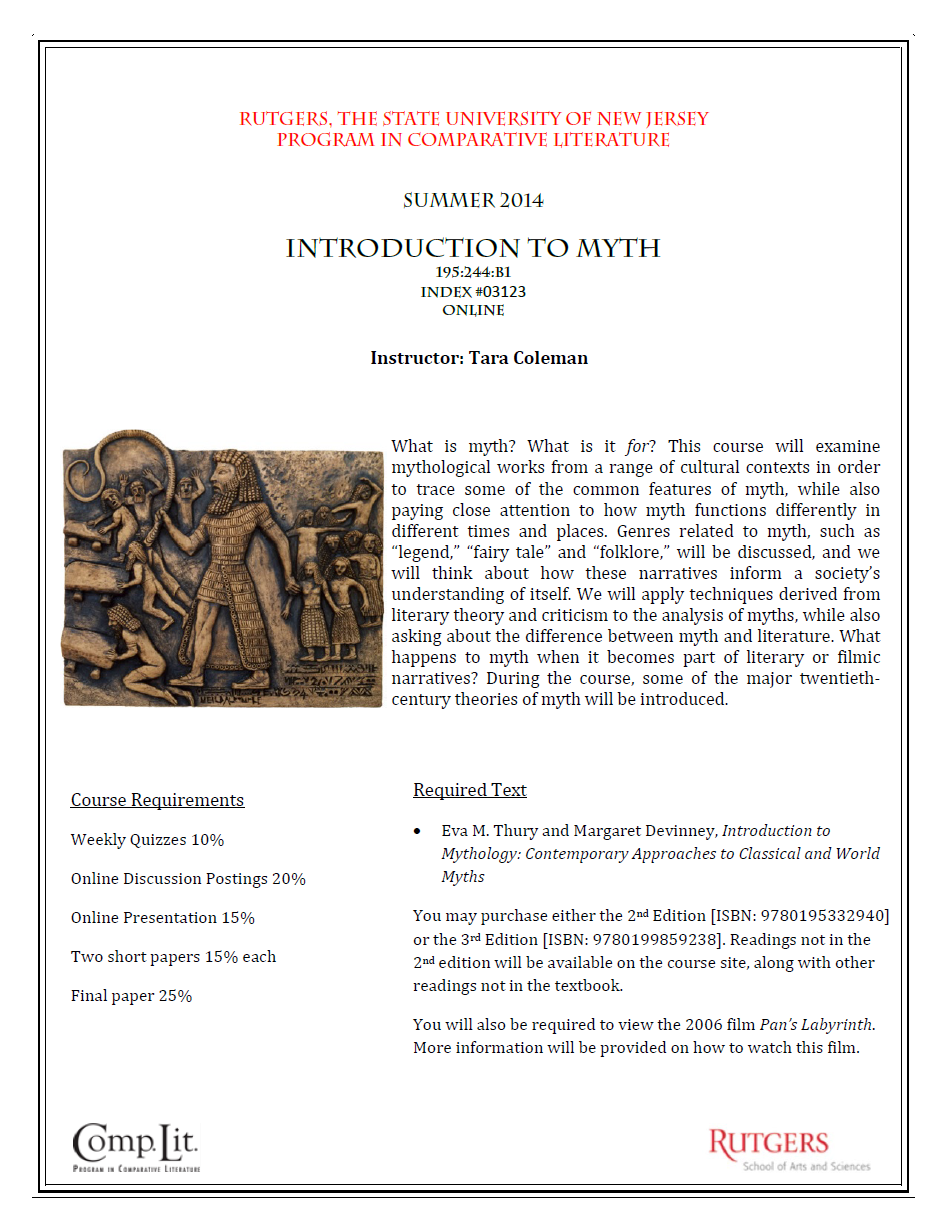
What is myth? What is it for? This course will examine mythological works from a range of cultural contexts in order to trace some of the common features of myth, while also paying close attention to how myth functions differently in different times and places. Genres related to myth, such as “legend,” “fairy tale” and “folklore,” will be discussed, and we will think about how these narratives inform a society’s understanding of itself. We will apply techniques derived from literary theory and criticism to the analysis of myths, while also asking about the difference between myth and literature. What happens to myth when it becomes part of literary or filmic narratives? During the course, some of the major twentieth-century theories of myth will be introduced.
Course Requirements:
Weekly Quizzes 10%
Online Discussion Postings 20%
Online Presentation 15%
Two short papers 15% each
Final paper 25%
Required Text:
Eva M. Thury and Margaret Devinney, Introduction to Mythology: Contemporary Approaches to Classical and World Myths .
You may purchase either the 2nd Edition [ISBN: 9780195332940] or the 3rd Edition [ISBN: 9780199859238]. Readings not in the 2nd edition will be available on the course site, along with other readings not in the textbook.
You will also be required to view the 2006 film Pan’s Labyrinth. More information will be provided on how to watch this film.
______________________________________________________________________________
Introduction to Mythology - THIS IS AN INTERNET COURSE
195:244:H1; Index 03127; 07/07/2014 – 08/13/2014
Hours by Arrangement
$100 Online Course Support Fee
Online via e-College http://ecollege.rutgers.edu
Instructor: Hsieh
In ths class, we will read and enjoy a range of world myths from different periods of time. In reading the canonical works of mythology, the students will be introduced critical approaches to understanding the cultural and historical contexts embodied in mythology. Since mythology is never a finished product bur rather a continuous meaning-making process, we will look into contemporary popular culture and see how we construct myths on the daily basis.
Required Texts:
All the required readings are readily available in PDF files via ecollege course shell.
Grading:
Discussion Forum Postings 40%, Quizzes 20%, Discussion Leader 10%, Two 5-page papers (30%).